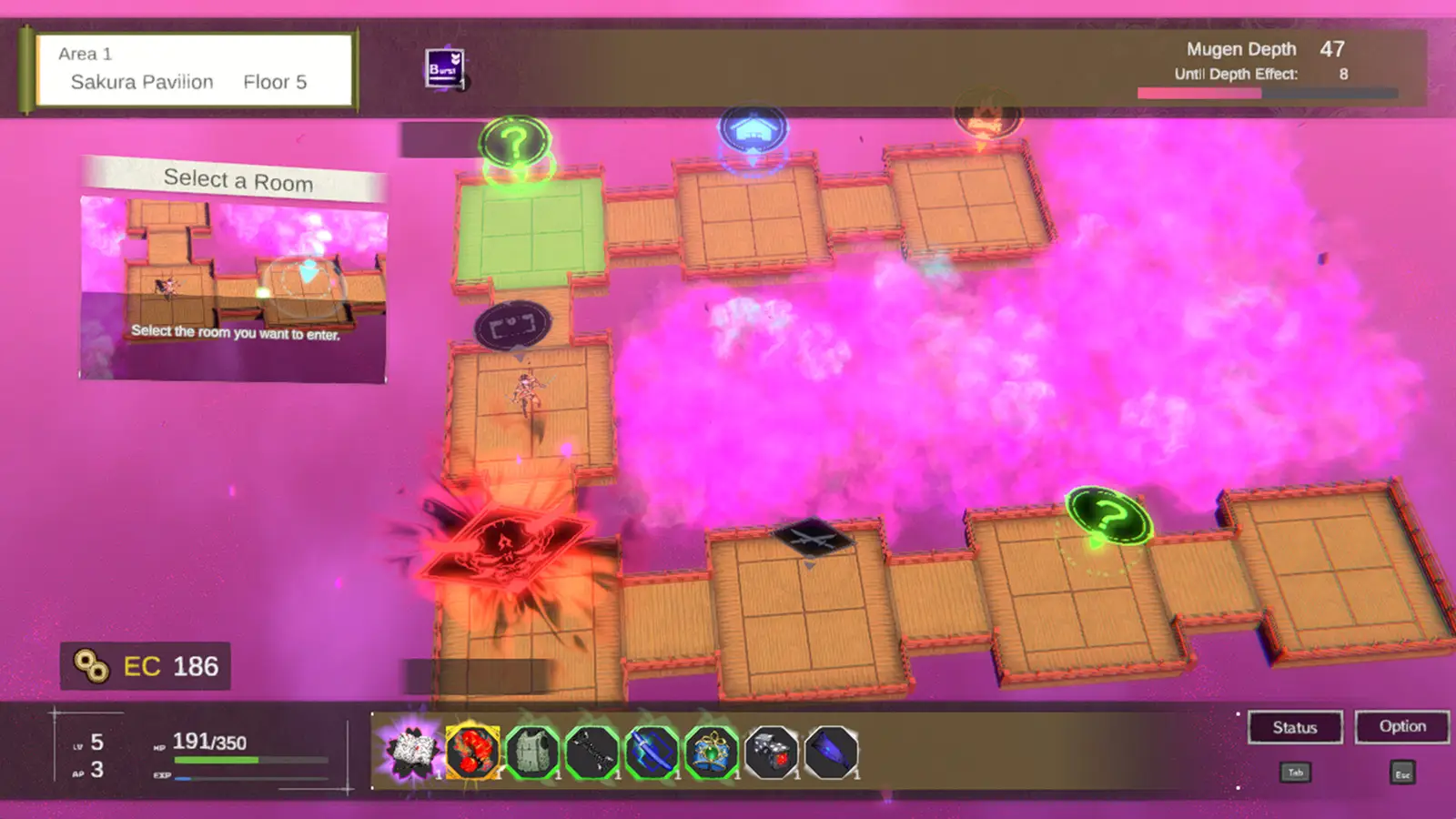
The English map HUD labels the risk meter Mugen Depth. The Japanese label is 夢幻深度. Next to it, the same HUD prints “Until Depth Effect” and a countdown. That countdown is the only official hint that depth is a timer, not a score you want to maximize.
What raises it
GameWith, 4Gamer, and Colorful Media agree on the common raises: moving between rooms, taking the reward in a treasure room, healing in a rest room, and entering the boundary gap (境界の狭間). NoobFeed adds that walking back along a path also raises it. That last claim is one review, so I keep it separate from the shared list.
A Steam screenshot of Area 1, floor 5, shows Mugen Depth 47 and Until Depth Effect 8, with 186 Eternal Coins. I use that frame as a picture of the HUD, not as a recommended depth.
What lowers it, and what it does to you
The sakura room (桜の間) spends HP to drop depth, remove a depth effect, or trade for a special Attribute. You can pick more than one option, and the cost climbs. NoobFeed also says a shrine can heal or clear depth. The ten-room table on Colorful Media does not include a shrine, so I file the shrine under that one review.
Published examples of depth effects: enemy HP and attack rise, shops get more expensive, vision narrows, and leveling gets harder. GameWith says the displayed cap is 100, and that debuffs keep stacking after the number stops climbing. Sakura Trials can cut your starting depth by 2, 3, or 5, and can lower the depth-effect cap by 1. Those trial rewards are in the achievement table.
Questions
Is 100 the hardest the run can get?
GameWith says the number stops at 100 and the debuffs continue to stack past that display cap.
Does every room raise depth?
Movement, treasure rewards, rest healing, and the boundary gap are the shared reports. A shrine rule appears in one review only.
Related
Sources
- GameWith early guide — checked 2026-11-07
- 4Gamer hands-on and interview — checked 2026-11-07
- Game*Spark play report — checked 2026-11-07
- NoobFeed review — checked 2026-11-07
- Vulgar Knight review — checked 2026-11-07
- Colorful Media room guide — checked 2026-11-07
- Steam store page — checked 2026-11-07